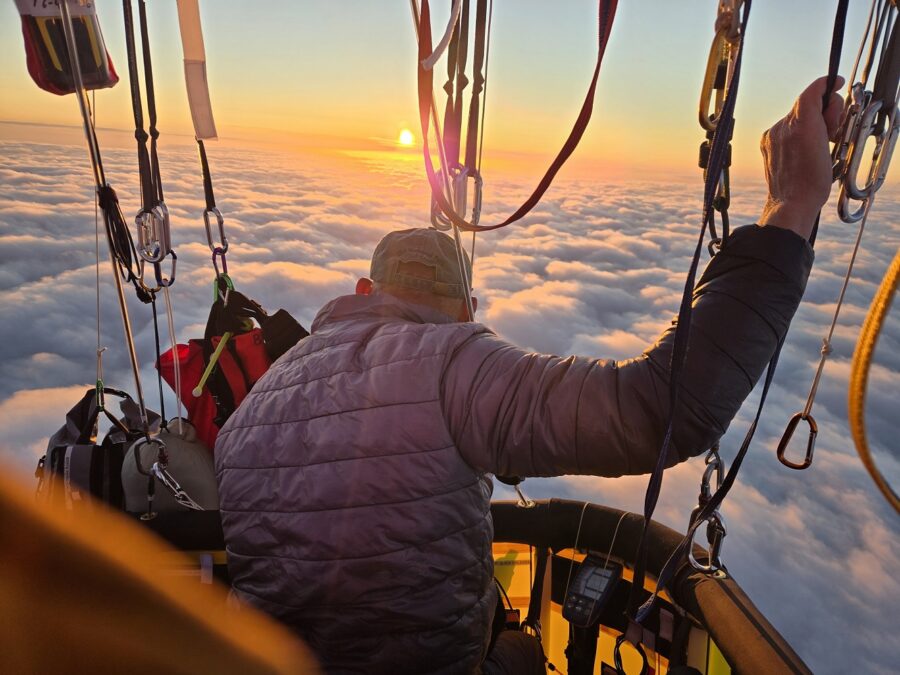
During a historic transatlantic balloon flight in June 2026, three balloonists found themselves surrounded by rain, snow, and the threat of lightning. For half an hour, they experienced St. Elmo’s fire, an eerie electrical phenomenon that appeared around their small, open basket. Above them was a massive balloon filled with 90,000 cubic feet of highly flammable hydrogen.
The journey had started on June 4, when Bert Padelt, Peter Cuneo, and Alicia Hempleman-Adams launched from Presque Isle, Maine. Carried eastward by powerful winds, their balloon reached speeds exceeding 90 mph (145 km/h). Thousands of feet below lay the Atlantic Ocean. There was no cabin, no heater, and nowhere to escape the weather. Yet the three balloonists had to keep their balloon airborne long enough to reach Europe.
They were attempting something no one had accomplished before: crossing an ocean in a balloon lifted entirely by hydrogen gas.
It was an achievement 243 years in the making.

The history of human ballooning began in 1783 with two remarkable inventions. On November 21, Jean-François Pilâtre de Rozier and the Marquis d’Arlandes made the first free human flight in a hot-air balloon developed by the Montgolfier brothers. Just ten days later, on December 1, 1783, Jacques Charles and Nicolas-Louis Robert took to the skies in a hydrogen-filled balloon. These two methods of achieving lift would shape the future of lighter-than-air aviation.
Unlike powered aircraft, balloons depend on the winds to carry them toward their destinations. Pilots control their altitude to take advantage of winds blowing in different directions, allowing them to influence their course. For more than two centuries, balloonists explored the possibilities of lighter-than-air flight, pushing the boundaries of altitude, distance, and endurance. Yet crossing an ocean remained an extraordinary challenge.
In December 1958, four adventurers attempted to cross the Atlantic Ocean from the Canary Islands aboard Small World, a hydrogen-filled balloon. Their gondola was specially designed to serve as a sailboat in the event of an emergency landing at sea. After three days aloft, the balloon was forced to ditch in the Atlantic. The crew detached the balloon, rigged the gondola for sailing, and eventually reached Barbados in January 1959, after nearly three weeks at sea.
The challenge of crossing the Atlantic by balloon was finally overcome on August 17, 1978, when Maxie Anderson, Ben Abruzzo, and Larry Newman completed the journey in a helium-filled gas balloon. Their achievement demonstrated that an unpowered balloon could remain airborne long enough to cross a vast expanse of ocean, provided the pilots could take advantage of favorable weather conditions and winds while carefully managing the gas and ballast.
The Pacific Ocean presented an even greater challenge. In 1981, Abruzzo and Newman, joined by Ron Clark and Rocky Aoki, completed the first balloon crossing of the Pacific, again using a helium balloon. Three years later, Joseph Kittinger became the first person to fly solo across the Atlantic in a helium balloon, undertaking an extraordinary adventure that demanded endurance, skill, and courage.
Meanwhile, improvements in balloon design and technology opened new possibilities for long-distance flights. In 1987, Richard Branson and Per Lindstrand became the first to cross the Atlantic in a hot-air balloon, followed by the Pacific in 1991, achieving another historic first. Unlike conventional gas balloons, hot-air balloons use burners to heat the air inside their envelopes to climb. To descend, pilots allow the air to cool or open a vent at the top of the envelope to release hot air. This enables pilots to control altitude without releasing valuable lifting gas or dropping ballast.
To remain airborne longer, balloonists developed the modern Rozière balloon, based on a design conceived in 1785 by French aeronaut Jean-François Pilâtre de Rozier, after whom it was named. His original balloon combined hydrogen and hot air, but modern versions use nonflammable helium instead of hydrogen. A helium-filled gas cell sits in the upper part of a larger envelope, with a separate chamber below where air is heated by burners. By using burners to control altitude, these hybrid balloons conserve gas and ballast, allowing them to stay airborne much longer.
In March 1999, Bertrand Piccard and Brian Jones completed the first nonstop balloon circumnavigation of the globe in a Rozière. Steve Fossett followed in 2002 with the first solo nonstop balloon flight around the world, also in a Rozière. In 2016, Fedor Konyukhov completed another solo circumnavigation, setting a new speed record. These achievements showed how advances in balloon technology, meteorology, and navigation had transformed the possibilities of long-distance flight.
Yet amid these extraordinary accomplishments, one milestone remained elusive: crossing an ocean in a conventional balloon using hydrogen as its sole lifting gas.
Hydrogen had been used in ballooning since its earliest days and continues to be used in long-distance gas balloon competitions, including America’s Challenge and the Gordon Bennett races. Hydrogen-filled powered airships had also crossed the Atlantic decades earlier. But crossing an ocean in an unpowered hydrogen balloon presented a different set of challenges.
Hydrogen, the lightest gas, provides more lift than helium but is highly flammable. Nonflammable helium therefore offers an important safety advantage, particularly on long flights over vast oceans. However, helium is scarce and costly.
Unlike a hot-air balloon or a Rozière, a conventional helium or hydrogen gas balloon has no heating system. Its pilots must carefully manage a finite supply of gas and ballast to control altitude. Cooling temperatures, changing atmospheric conditions, and the need to release ballast can reduce the balloon’s endurance. Completing an ocean crossing therefore depends on finding a favorable weather system that can carry the balloon across the water before its resources are exhausted.
These limitations, combined with hydrogen’s flammability, help explain why a hydrogen-only ocean crossing remained such a formidable challenge, even after balloonists had circumnavigated the globe.
On June 7, 2026, that long-standing milestone was finally achieved. After 70 hours and 11 minutes in the air, Bert Padelt, Peter Cuneo, and Alicia Hempleman-Adams completed the first Atlantic balloon crossing using hydrogen as the sole source of lift. Their flight from Presque Isle, Maine, to Luxembourg marked a new chapter in the history of lighter-than-air aviation.
For Padelt, a veteran balloon designer, manufacturer, and gas-balloon pilot, the achievement fulfilled a dream he had pursued for more than half a century.
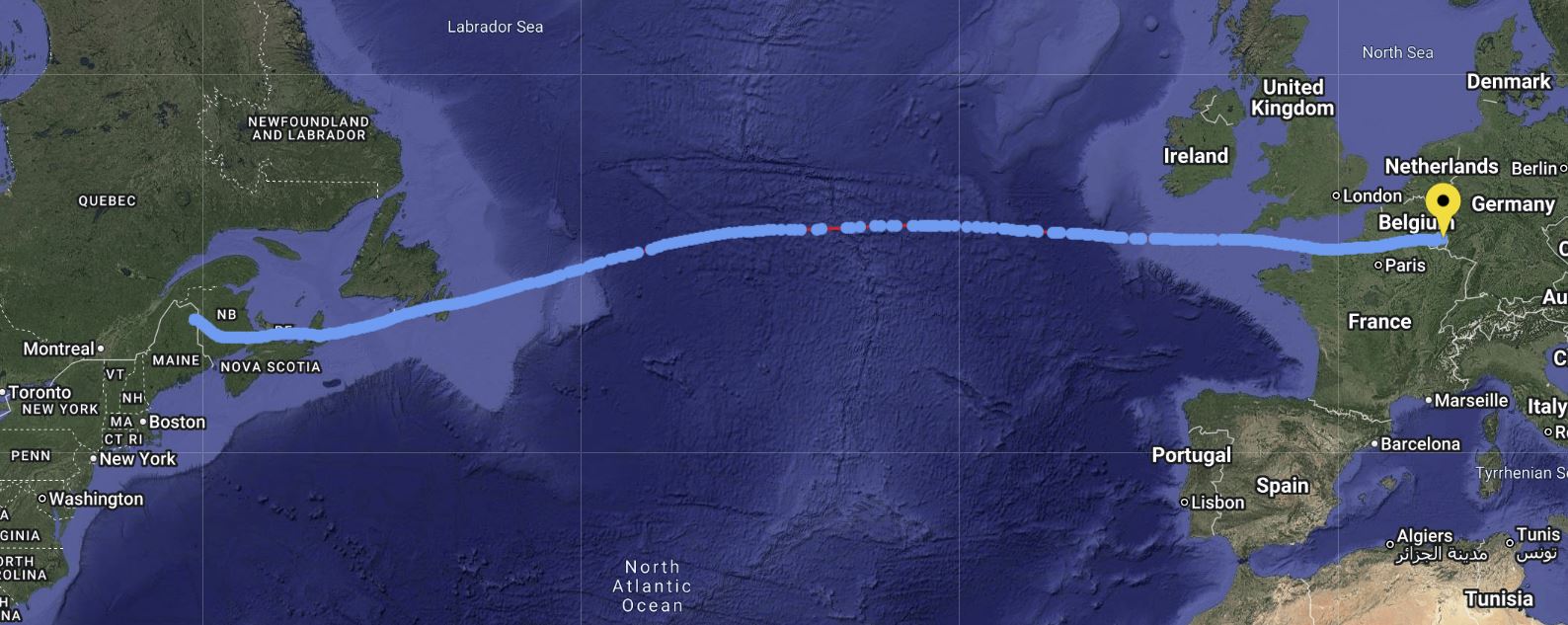
In this in-depth interview with LTA Science & Flight, Padelt recounts the years of preparation, unpredictable weather, technical challenges, and critical decisions behind the historic crossing. In Part 1, he describes the preparations and early stages of the flight, including a severe Atlantic storm that tested both the balloon and its crew.
Planning, permissions, and preparations
Sitara Maruf: Bert, congratulations to you, Peter, and Alicia on this historic achievement. I’m so glad you all returned safely. Your courage and perseverance have been incredible. Thank you for taking the time to speak with LTA Science & Flight.
Bert Padelt: Thank you. Well, it was something I really wanted to do, and I was very fortunate to have the support of a lot of people, including my wife.
Sitara Maruf: Let’s start with the planning. How do you even go about getting permission to fly a balloon across the Atlantic? What regulatory clearances did you need?
Bert Padelt: To get permission to fly across the Atlantic, you have to get involved with Transport Canada. Over the Atlantic, anything above 5,000 feet is Class A airspace, so you have to have a waiver. Transport Canada issues the waiver. With our waiver, we had a 100-mile radius around us for the entire Atlantic crossing, and we were allowed to fly as high as 17,000 feet.
We were required to communicate with Gander (the Canadian air traffic control center responsible for a large portion of North Atlantic airspace) every hour or every five degrees of longitude, providing status and position reports. Once we passed 30 degrees west longitude, we would communicate with Shanwick Oceanic Control, which manages air traffic over the eastern North Atlantic.
Transport Canada issued the waiver about two months before our launch window opened. It remained valid throughout the entire three-month window. There was no issue with the gas we were using. It was more of an airspace issue.
Sitara Maruf: What did you learn from the previous two attempts, and what concerns did you have before trying again?
Bert Padelt: Our first attempt in 2024 was unsuccessful because of unfavorable weather conditions. You try to be as prepared as possible, and you put your trust in the meteorologists.
Don Day was the meteorologist for our second attempt. Don is a very good friend of mine and has handled the weather for most of my long-distance gas balloon flights. On the first Atlantic attempt, we used another meteorologist. I didn’t want to involve Don because he’s such a good friend, and if something happened to me, I didn’t want to put that pressure on him. We worked through that, and for the second attempt, Don was more than happy to handle the weather, and I was more than happy to have him.
On the second attempt, we had what we thought might be a gas leak in the balloon, although atmospheric conditions could also have been responsible. The frustrating thing was that we never knew exactly why the balloon behaved the way it did.
Going into the third attempt, I felt some apprehension. When we rebuilt the balloon, I did everything possible to make sure there wouldn’t be a gas leak. But you never really know until you take off and fly. If the balloon performs well during the first hour, you can be fairly confident that you have a sound balloon. This year, after reaching our planned altitude and flying for about an hour, I knew right away that the balloon was performing well.
My biggest apprehension was another failure. I didn’t want to make a third attempt, knowing that so many people would be watching, and have something go wrong. It was very frustrating after the second failure because I know how to do this. I know how to be successful, and I’ve done it for so many other people. It’s one thing if the problem is weather, but it’s another if it’s equipment. That was my biggest concern. As far as preparations went, this last attempt was actually very easy because I already had everything in place.
Sitara Maruf: I understand you had to build a new balloon because the previous one was damaged. How did you test and certify the new balloon for flight? Was a test flight necessary?
Bert Padelt: The balloon used in our second attempt was not damaged during the landing, but it was damaged while being recovered from the area. So yes, the balloon was rebuilt.
It was inflated with cold air and pressurized, so a pressure check was done before we flew. But we did not fly the balloon beforehand.
Everything else has to work properly as well. All your communications have to be working, along with the balloon and other equipment. It doesn’t make sense to go out over the water unless everything on the checklist has been properly checked. It’s not just the balloon; it’s also the equipment and communications.
Sitara Maruf: What weather patterns do meteorologists look for when planning a long-distance balloon flight across the Atlantic? I understand your launch was delayed by four hours, which had consequences later in the flight.
Bert Padelt: The delay was not that big a deal because the window was pretty wide open. We had about an eight-hour window to get into the air. Ideally, the meteorologists are looking for a ridge of high pressure coming across, and that ridge of high pressure, as a general rule, is being pushed by a low-pressure system. The idea is to launch the balloon into a ridge of high pressure and gradually climb to higher altitudes as the flight progresses to remain within that weather system.
You fly that ridge of high pressure across the Atlantic. That’s the ideal scenario.
Sitara Maruf: What altitude had you planned, and how did the actual flight differ?
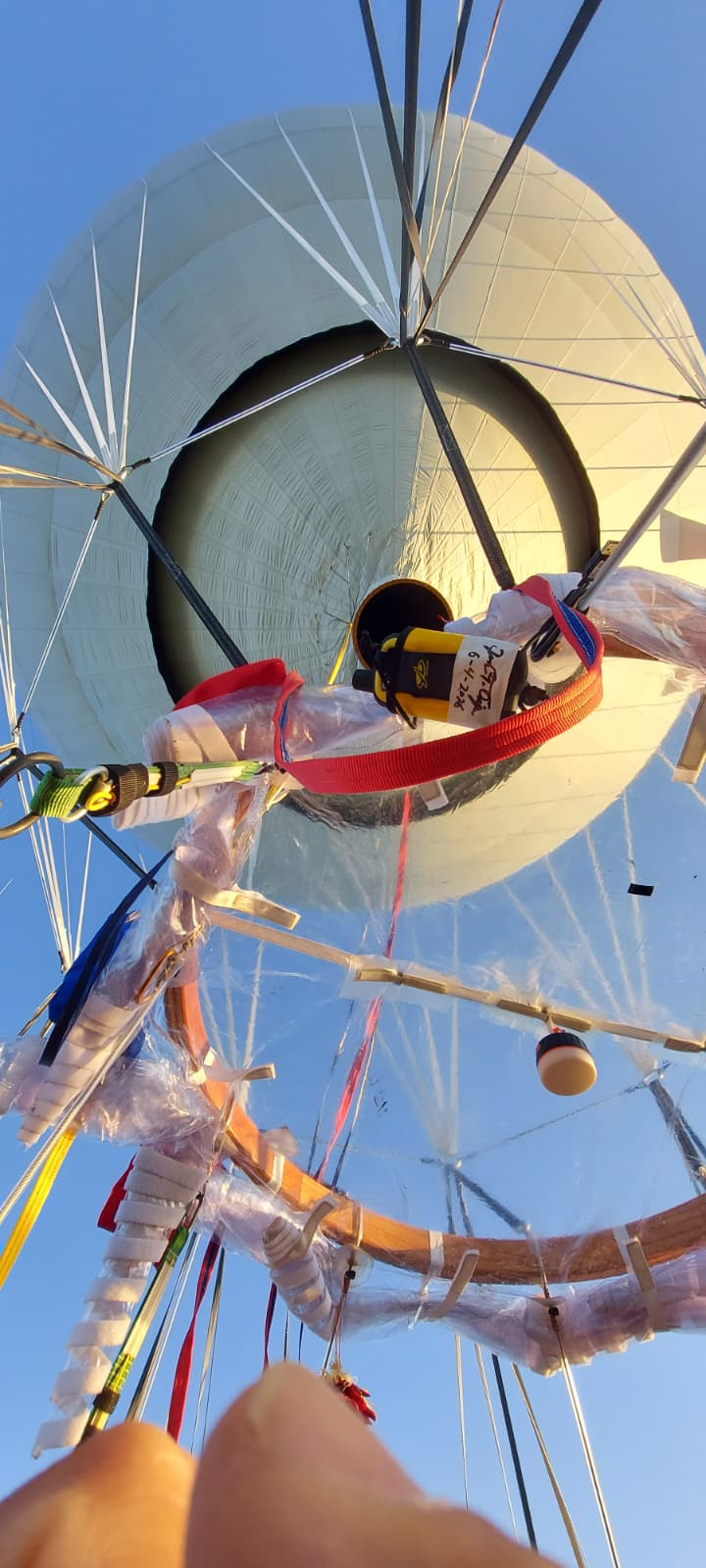
Bert Padelt: With that waiver, we were told they were giving us 17,000 feet. If we wanted to go higher, we had to ask permission, and they could not guarantee it. The last morning we were over the Atlantic, the balloon had a lot of ice on it. The day before, there was bad weather to the north of us moving faster than we were.
For about six hours, we were under the influence of that weather. We had a lot of snow and water, and that froze. We had about 300 pounds of weight on the balloon that shed the next morning. When that weight came off, the balloon wanted to climb. We quickly called and got permission to go to 20,000 feet. Once we were there, the balloon still wanted to climb higher, and we got permission to go to 23,000 feet.
If we hadn’t received permission, we would have had to valve gas and stay below. But the balloon wanted to be at that altitude, and the meteorologists were happy, because we were staying away from bad weather to the north as we came into Europe. Staying high like that was ideal.
The first day and the Atlantic
Sitara Maruf: How did the balloon perform during the first day, particularly at sunset?
Bert Padelt: As a general rule, when the sun starts to set, you start ballasting about three hours before sunset because the balloon is cooling. On our flight, the balloon started cooling about five hours before sunset. We started using ballast five hours before sunset to keep it in the air. The meteorologists felt that because we were so far north, and the angle of the sun was such, the cooling started earlier than we anticipated. So the first evening, we went through a little more ballast than we anticipated.
That night we briefly talked about the possibility of landing in Newfoundland, because it was a little bit of a concern. However, we still had enough ballast, with the speed that was forecast, to get across the Atlantic. We weren’t anticipating the storm that came and caused us to use more ballast. At that point, we felt it was more dangerous to land in Newfoundland than to continue. The landing would have been at night; we would have been off Newfoundland by sunrise, and there would have been about 30 knots of wind on the surface. Based on the ballast we had and the poor conditions for landing, it was an easy decision to continue.
Sitara Maruf: What was it like leaving Canada behind and heading out over the Atlantic?
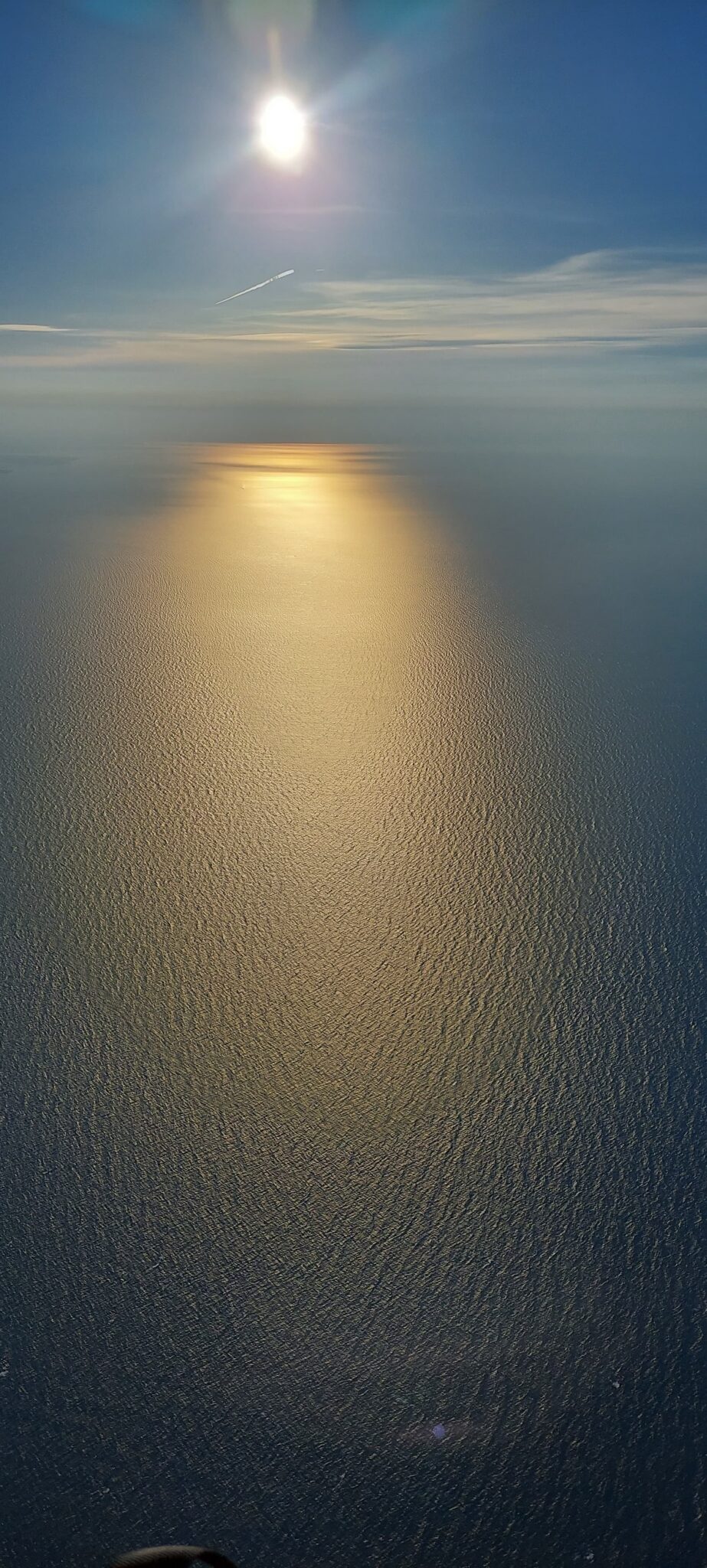
Bert Padelt: I remember the first day, flying across New Brunswick and then over Prince Edward Island. We were down at about 4,000 feet, and it was very pretty. I remember crossing Cape Breton Island and going out over the Atlantic. The sound of the ocean was very loud. That was an eye-opener for me. It was like, finally, I hear the ocean, and this is real. I think that emotion was as strong as the emotion when we got to the other side. I was finally going out over the water.
You’re pretty busy the whole time you’re flying. Whether you’re communicating, navigating, trying to sleep, or eating, you’re always doing something. But on this flight, the sound of the ocean never went away. Maybe it did when we were at 23,000 feet. Before that, you could hear the roar of the ocean in the background constantly. It was loud. As the flight continued and we got higher, that noise went away.
For me, it was extremely exciting because I was finally doing it. After the last two attempts, when we didn’t even get to the ocean, I kept thinking, all I want to do is see Canada in my rearview mirror. Once you get out over the water, everything changes, because now you’re going to do everything you possibly can to keep the balloon in the air and get to the other side. When we crossed the coast, it became very real. You could still hear the ocean at 15,000 feet.
Weather, altitude, and difficult decisions
Sitara Maruf: What happened when you encountered the severe weather over the Atlantic?
Bert Padelt: We weren’t in a thunderstorm. There were thunderstorms farther north of us as the low-pressure system passed by. We were close enough to hear thunder, but we saw no lightning. The thunder was pretty far off.
What certainly got our attention was a bout of St. Elmo’s fire that lasted about 30 minutes, during which everything in the basket was electrically charged. This was probably the most concerning part of the flight for me because, as a general rule, when you’re dealing with St. Elmo’s fire, the next thing that happens is a lightning strike. So that was a concern.
When we described the conditions to our meteorologist, Don Day, he confirmed they were exactly the kind of conditions in which he would expect St. Elmo’s fire.
Fortunately, the storm was moving quickly, and we were in it for only about six hours. We knew there was a possibility of encountering it, but we expected to be farther south, with the storm passing farther north. As it turned out, we were a little farther north, and the storm was a little farther south, so it caught up with us.
We weren’t in the brunt of the storm, but we encountered heavy rain as we descended. We released ballast and climbed back up into heavy snow. Then we rose above the storm into sunshine, and that’s when we heard the rumbles of thunder.
The balloon eventually settled out, and the sun went down, but it continued to snow during the first part of the night. The balloon kept accumulating ice, and I think we lost about two days of flight duration because of that icing.
We had to release 300 pounds of ballast. The next morning, that 300 pounds of ice fell off, and we climbed higher sooner than we should have. We should never have been at 23,000 feet. I had calculated that after four days of flying, we would only be at 17,000 feet.
The fact that we were at 23,000 feet meant we had released more ballast earlier than planned. But it all worked to our benefit because we got into much faster winds. In fact, the winds were faster than forecast.
Sitara Maruf: Did you feel the speed or any movement of the basket?
Bert Padelt: The only time we felt any motion during the flight was that morning when the sun came out and the ice shed off the balloon all at once. The basket swung a little because we were climbing at over 1,200 feet per minute—very fast for a gas balloon.
Otherwise, you’re moving with the wind, so you have no sense of speed at all, other than by looking at the GPS.
Sitara Maruf: Were there moments when you thought you might have to ditch in the ocean? Did you wear your immersion suits?
Bert Padelt: No, there was never a time when I felt we were in a position where we would have to ditch. Every time we encountered a difficult situation, we dealt with it properly, I think. For me, it was more exhilarating than anything else.
This was the whole reason I was doing this flight. I knew it was going to be difficult, and the challenges we faced were ones I had anticipated. There was never a moment when I thought, “This is it. We’re going to have to ditch.”
Alicia wore her immersion suit, but that was because of the cold. We had our immersion suits ready and were prepared to put them on if necessary, but I never felt there was a point when we needed to do so.
Sitara Maruf: How did the ground support team help you through these situations?
Bert Padelt: Most of our communications were with Kevin Stass, who was manning the command center. But I also had a good friend, Tomáš Hora, who is a very good gas balloonist. Whenever I had questions about how the balloon was performing, I communicated directly with Tomáš. It was extremely important for me to have someone like him to consult because he gave me a lot of peace of mind. During difficult moments, such as the storm or the first night when we were using ballast sooner than expected, being able to discuss the situation and bounce ideas off him was very important.
Please click this link to read Part 2: Bert Padelt discusses life aboard the balloon, communication and safety systems, the landing in Luxembourg, and his reflections on the historic crossing.
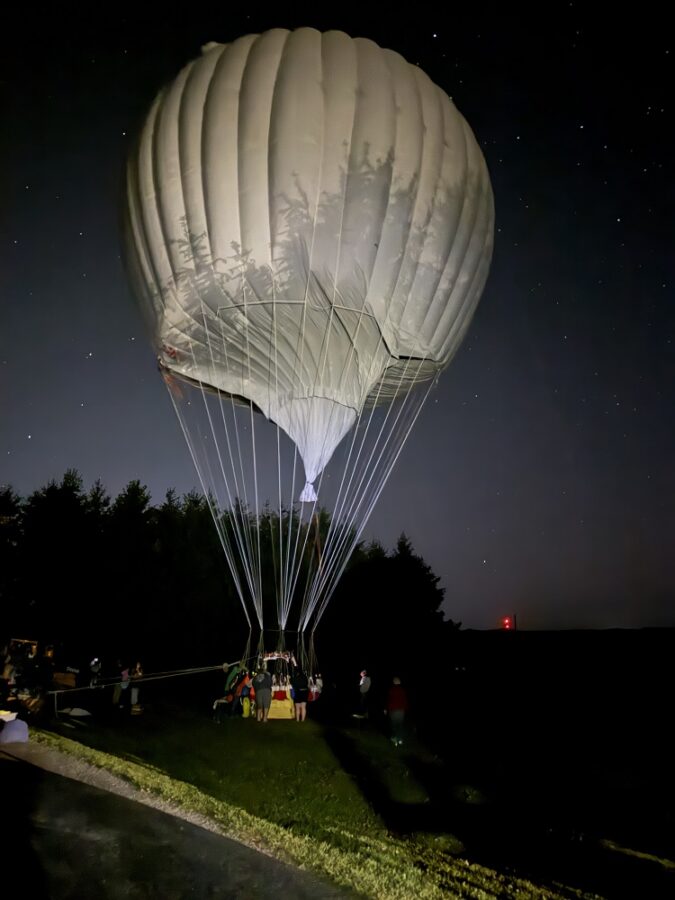
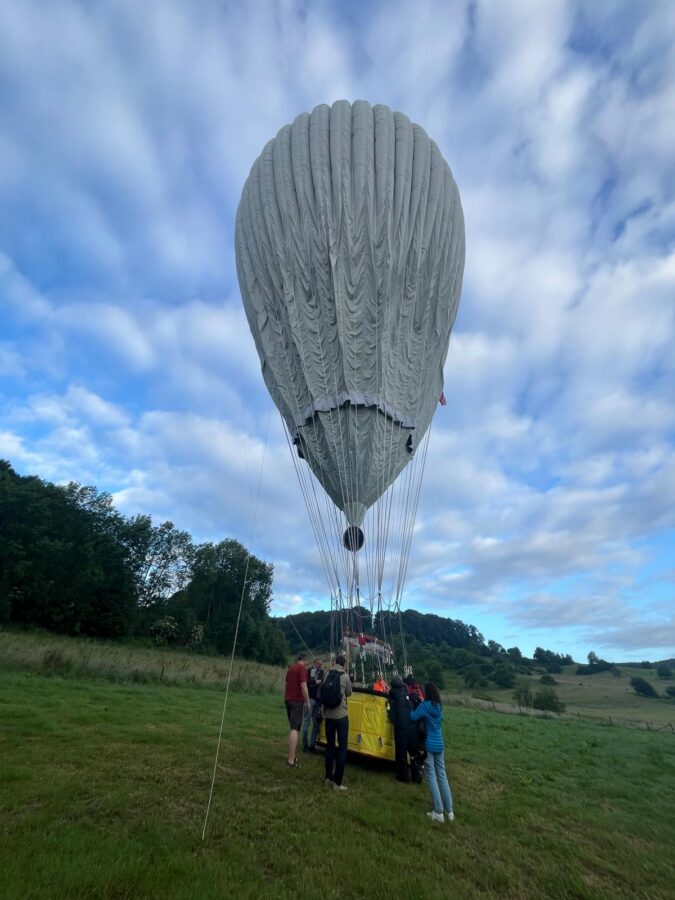
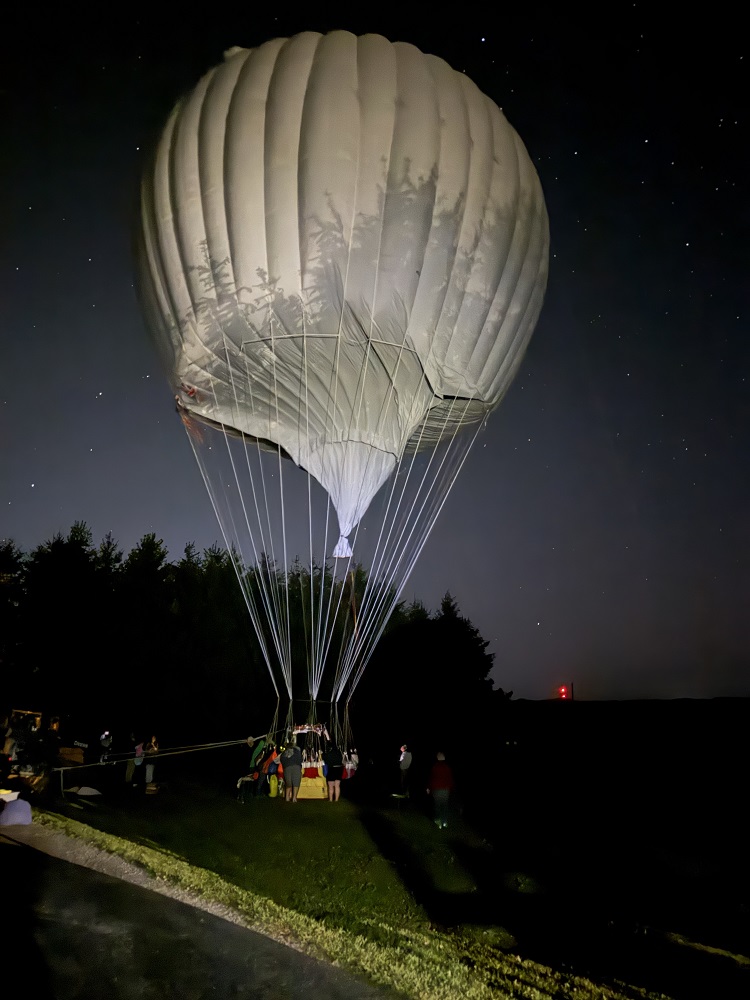
Featured photo: Atlantic Explorer during inflation at Presque Isle, Maine, June 3, 2026. Photo: Kim Vesely.
###